
After the defeat in the 1962 war with China, the Indian government requested Lieutenant General Henderson-Brooks and Brigadier Prem Bhagat to prepare a report. Fifty years later, it remains one of India's most secret documents. What on earth has stopped the government from revealing the report to the Indian public, asks Claude Arpi.
B Raman's book is exceptional because for the first time we get an insider's analysis of the success and failures of the secretive Indian external intelligence agency.
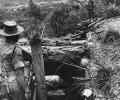
More than half-a-century after humiliation in the 1962 war, India is still not prepared to take on the Chinese dragon. Every now and then, that dragon flexes its muscles, reminding India the threat persists, says Virendra Kapoor.

No account of the 1962 war could be complete without Maxwell's authoritative analysis. Which is why we are reprinting this article which was run on Rediff.com in June 2001.
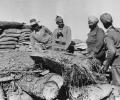
'The Himmatsinghji Report is still 'missing'.' 'It is a great loss for the knowledge of India's borders.' 'It would have an immense value at a time China is bound to shift its attention to other border fronts in the Himalayas,' notes Claude Arpi.

On the title page of the Top Secret Report, Henderson-Brooks quotes the Chinese tactician Sun Tzu: 'Know yourself, know your enemy: A hundred battles, a hundred victories', says Claude Arpi, highlighting where the Indian Army and government failed to counter the Chinese attack in 1962.

'I was exhausted, hungry, unshaven and despondent.' 'My mouth was full of sores due to dehydration.' 'My clothes were in tatters due to walking through bushes and sliding down thorny slopes,' Brigadier John Parshuram Dalvi wrote of his capture during the 1962 War.
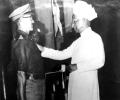
'Anglo-Indians have played a significant role at the forefront, meeting every challenge to the security of the motherland.' A fascinating excerpt from Barry O'Brien's The Anglo-Indians: A Portrait of a Community.
'We fear worse things to happen. We feel this is just a teaser.' 'I wonder whether later, the Christian community will be targeted.'
It is well-known, and the Brooks-Bhagat report vouches for it, that the real failure for the 1962 debacle against China was not military, but political, says Ram Madhav.

'If only Cariappa/Thimayya/Chaudhari/Manekshaw were given a free hand, there'll be no PoK, the Chinese would have been taught a lesson, 1965 would have slain the Pak demon and in 1971 just another fortnight's fighting after Bangladesh and West Pakistan would have been occupied.' 'No authoritative military account suggests anything remotely like any of these...' '...Chronologies, names, even periods get mixed up, but, never mind, because the point -- strong Army denied by cowardly Congress -- is made.' 'This is where Modi is coming from,' points out Shekhar Gupta.
Nehru's sentimental attachment to the Mountbattens deeply vitiated the Kashmir issue. It was certainly the most important factor for the failure to find a solution in the first years of the conflict.
